A major sporting goods manufacturer asked the Data Driven Supply Chain (DDSC) team to review their B2B fulfillment network.
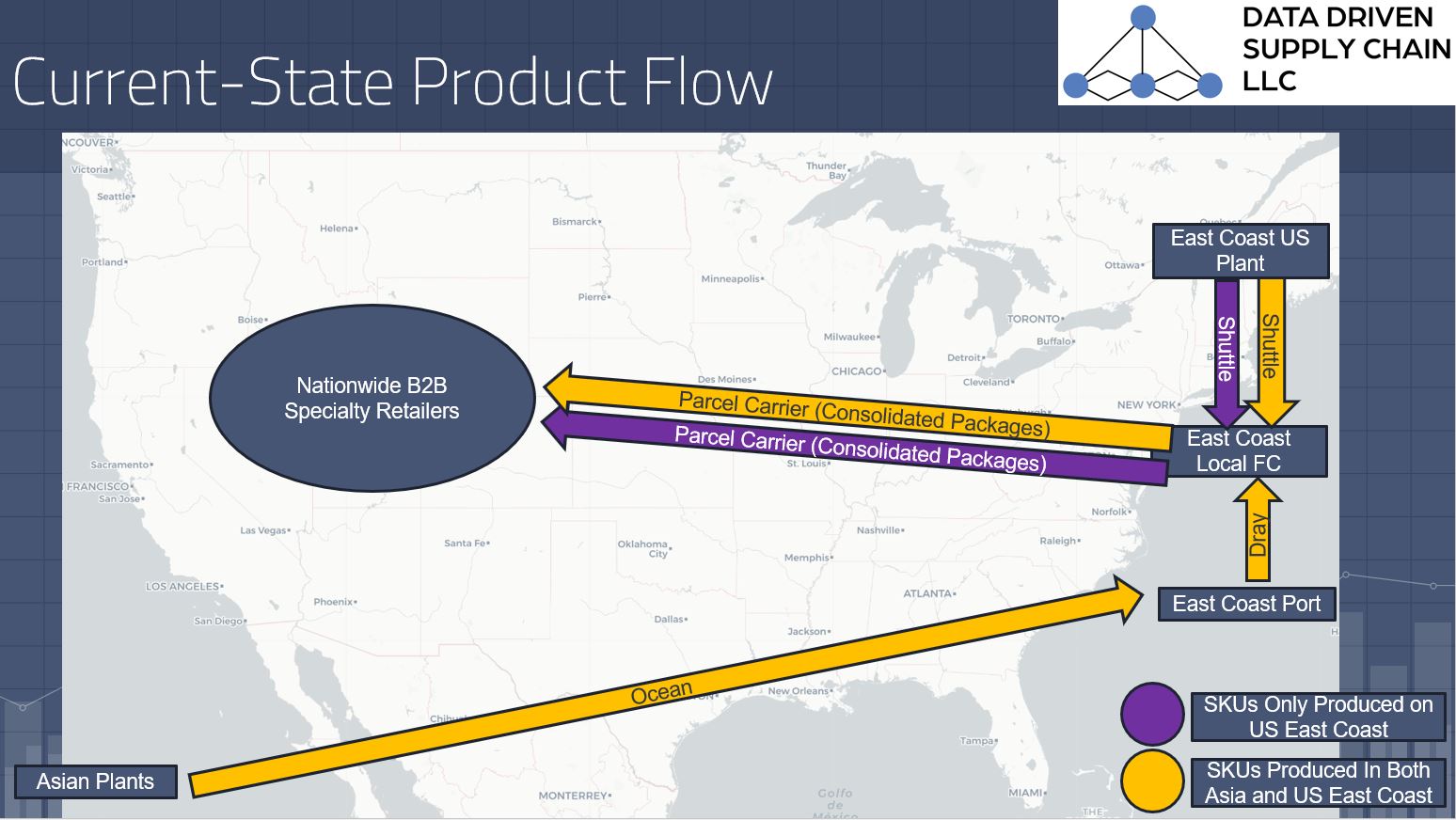
This market leader manufactures its product from a facility on the US East Coast and ships via parcel carrier to specialty retailers nationwide.
Due to capacity constraints in the East Coast facility, the company also uses Asian contract manufacturing to dual-source the most popular SKUs. These units are then sent via ocean carrier to an East Coast port, then via drayage to the company’s East Coast facility for customer fulfillment.
As such, the company has some SKUs that are dual-sourced (manufactured in both the East Coast and Asia) and some SKUs that are single-sourced (manufactured only on the East Coast).
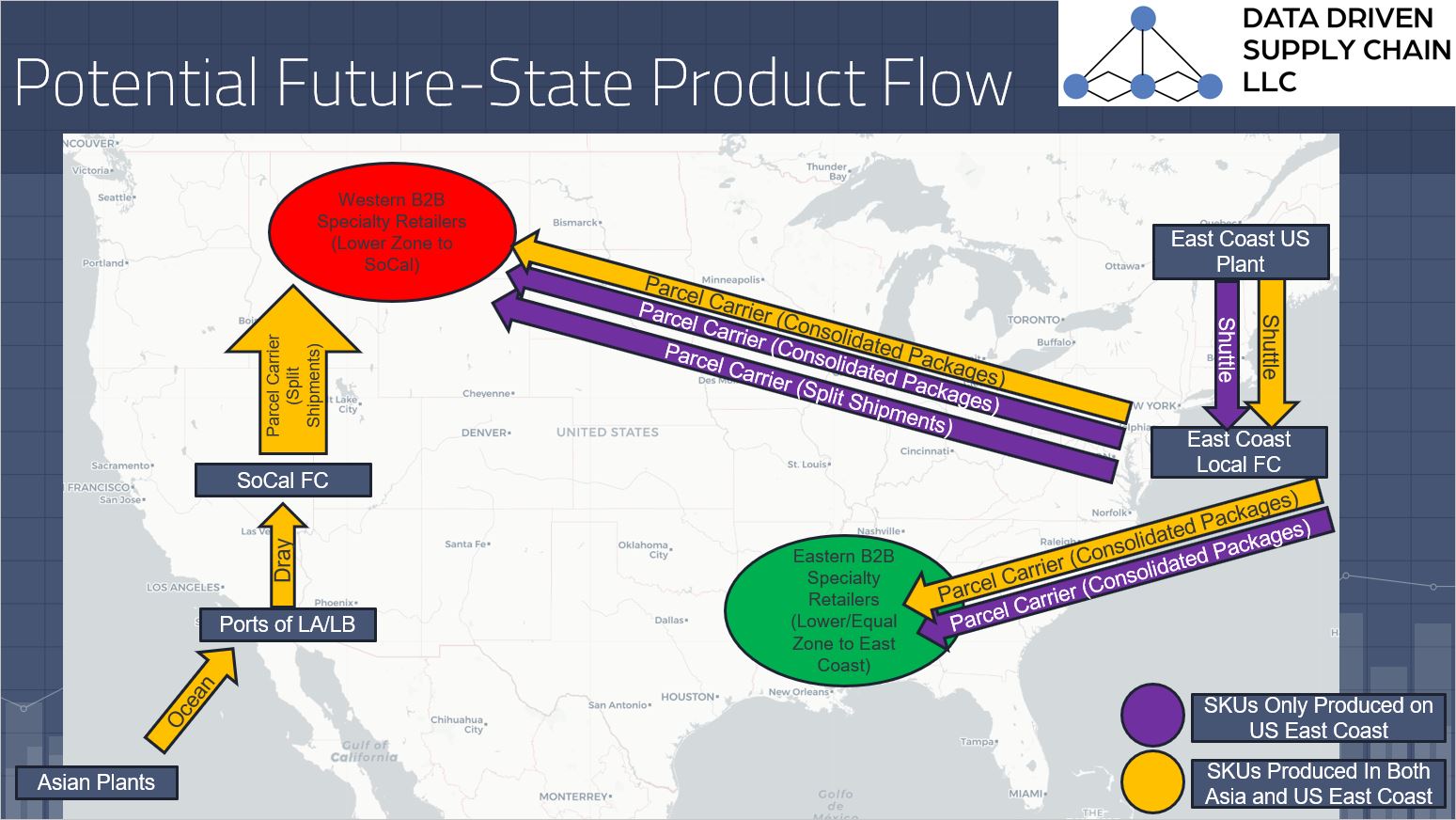
Company leaders were considering shipping all the Asian-produced units to the ports of Los Angeles and Long Beach, then via drayage to a nearby Southern California fulfillment center. From there, they would be sent via parcel carrier to customers in the western US, saving on last-mile fulfillment costs.
The sporting goods manufacturer asked the Data Driven Supply Chain team what would be the financial benefit of making this change?
Considerations
At first approximation, when you ship something via a parcel carrier, cost goes up with to distance: the further you ship a box, the more you pay.
From a common-sense perspective, one would logically assume that shipping from Southern California, instead of the East Coast, to customers in the western half of the country would reduce total parcel expense.
However, other considerations needed to be evaluated, including:
- You are now shipping from multiple locations, adding operational complexity
- You will have the expense of operating an additional fulfillment center in Southern California, possibly at higher unit cost than the East Coast
- Changing import location will result in a process change and possibly compliance changes
- Customer orders can be composed in multiple ways:
- Only single-sourced, domestically produced SKUs, which must be shipped from the East Coast
- Only dual-sourced SKUs, which can be shipped from either SoCal or the East Coast, whichever is closer to the customer
- A mix of single-sourced and dual-sourced SKUs. For these orders, you must decide whether to: a) consolidate and ship from the East Coast, or b) split the order, shipping dual-sourced SKUs from SoCal and single-sourced SKUs from the East Coast
The Data Driven Supply Chain Approach
The Data Driven Supply Chain reviewed the company’s delivery data and cost structures. They examined every single order to know:
- Where is the customer located?
- Where is that location relative to both the SoCal and East Coast fulfillment centers?
- What did the customer order? Were the products single-sourced SKUs, dual-sourced SKUs, or both?
Outcome
DDSC’s greatest value-add was the ability to quickly analyze all relevant data to quantify the expense reduction from opening a SoCal fulfillment center.
For some of the SoCal fulfillment center’s closest (“zone 2”) customers, there would be a financial benefit from splitting the shipment: getting low-cost zone 2 shipping from SoCal where possible, and long-shipping from the East Coast where necessary. While not true in every case, this strategy did frequently outweigh the consolidation benefits of long-shipping the entire order from the East Coast to the southwestern US.
As may be expected, this effect was lessened in areas like Dallas-Fort Worth and Houston. While lower-zone to SoCal than the East Coast, the benefits of consolidation tended to outweigh the benefits of split-shipping to these customers.
The final analysis showed that approximately 5% of logistics cost (ocean + parcel) could be realized by opening a SoCal fulfillment center and proper ship node selection. While these savings were primarily driven through lower parcel cost, there was a small savings contribution by reduced ocean freight into LA/LB as compared to an East Coast port.
To learn more about our supply chain design consulting, read case studies or contact us.
To receive content like this and other updates from Data Driven Supply Chain, sign up here. You can unsubscribe at any time.